
Introduction
Osteoarthritis (OA) is an inflammatory joint disease that primarily damages articular cartilage. It is characterized by progressive degradation of cartilage involving the entire joint tissue, ultimately leading to joint degeneration, fibrosis, fracture, defect formation, and damage to the entire articular surface.1 Globally, epidemiological data indicate that approximately 355 million people are affected by arthritis, making it the leading cause of disability worldwide. OA management is largely based on individualized and graded treatment strategies depending on disease severity.2
Pathophysiology of OA
OA is not limited to cartilage wear but involves the entire joint unit, resulting in progressive structural and functional deterioration.
- Progressive degradation of articular cartilage
- Involvement of all joint tissues leading to structural instability
- End-stage changes include fibrosis, fractures, and joint surface destruction
- Leads to chronic pain and functional disability
This multifactorial degeneration necessitates long-term management strategies targeting both symptoms and underlying inflammation.
Conventional management approaches
Current management of knee OA focuses on symptomatic control and functional improvement through pharmacological and non-pharmacological approaches.
- Individualized and severity-based treatment planning
- Main pharmacological agents include NSAIDs
- Cyclooxygenase-2 (COX-2) inhibitors are also commonly used
- Aimed primarily at pain reduction and inflammation control
Despite widespread use, long-term management remains challenging due to persistent disease progression.
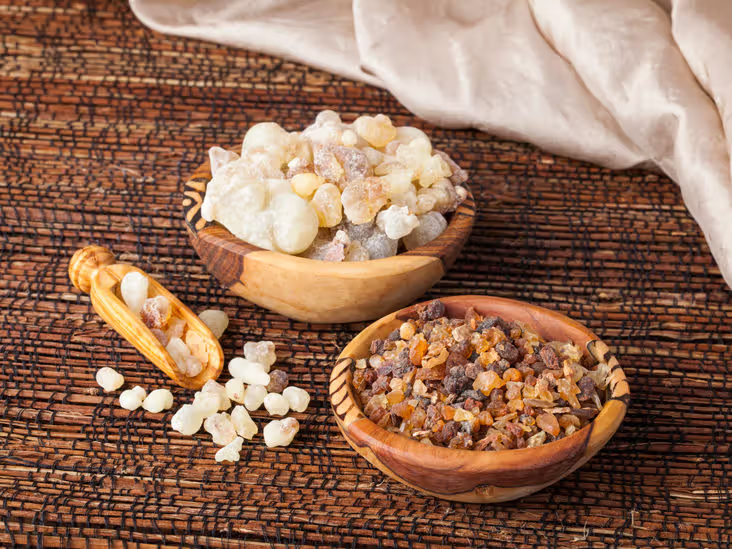
Boswellia serrata and anti-inflammatory activity
Boswellia serrata is a well-documented medicinal plant with significant anti-inflammatory properties. Its active component, boswellic acid, demonstrates therapeutic relevance in multiple inflammatory conditions.
- Boswellic acid shows pharmacological activity in rheumatoid arthritis, chronic bronchitis, asthma, ulcerative colitis, and Crohn’s disease
- Active compound AKBA contributes to anti-inflammatory effects
- Extracts such as 5-Loxin and Aflapin have demonstrated safety at higher doses
- Current evidence supports non-toxic nature of Boswellia serrata extracts
These properties support its role as a potential adjunct in inflammatory joint disorders such as OA.3,4
Safety considerations and clinical evidence limitations
Although Boswellia serrata shows therapeutic promise, clinical interpretation requires caution.
- Recommended dosage and duration require further standardization
- Clinical outcomes across 1–4 weeks have limited reported consistency
- Dosage ranges outside 100–250 mg are not well documented
- Existing randomized controlled trials are of medium to low quality
- Findings should therefore be interpreted with caution5
Conclusion
OA is a progressive inflammatory joint disorder affecting millions globally and remains a major cause of disability. While conventional therapies primarily focus on symptom control, Boswellia serrata offers a promising anti-inflammatory alternative due to its bioactive compound AKBA. However, limitations in clinical evidence and variability in dosing highlight the need for cautious interpretation and further high-quality research to establish its definitive therapeutic role.
References:
1. Walker-Bone K, Javaid K, Arden N, Cooper C. Regular review: medical management of osteoarthritis. BMJ. 2000;321(7266):936-940. doi:10.1136/bmj.321.7266.936. https://pmc.ncbi.nlm.nih.gov/articles/PMC1118736/
2. Pendleton A, Arden N, Dougados M, et al. EULAR recommendations for the management of knee osteoarthritis: report of a task force of the Standing Committee for International Clinical Studies Including Therapeutic Trials (ESCISIT). Ann Rheum Dis. 2000;59(12):936-944. doi:10.1136/ard.59.12.936. https://pmc.ncbi.nlm.nih.gov/articles/PMC1753053/
3. Singh GB, Atal CK. Pharmacology of an extract of salai guggal ex-Boswellia serrata, a new non-steroidal anti-inflammatory agent. Agents Actions. 1986;18(3-4):407-412. doi:10.1007/BF01965005. https://link.springer.com/article/10.1007/BF01965005
4. Sengupta K, Krishnaraju AV, Vishal AA, et al. Comparative efficacy and tolerability of 5-Loxin and AflapinAgainst osteoarthritis of the knee: a double blind, randomized, placebo controlled clinical study. Int J Med Sci. 2010;7(6):366-377. Published 2010 Nov 1. doi:10.7150/ijms.7.366. https://pmc.ncbi.nlm.nih.gov/articles/PMC2974165/
5. Yu G, Xiang W, Zhang T, Zeng L, Yang K, Li J. Effectiveness of Boswellia and Boswellia extract for osteoarthritis patients: a systematic review and meta-analysis. BMC Complement Med Ther. 2020;20(1):225. Published 2020 Jul 17. doi:10.1186/s12906-020-02985-6. https://pmc.ncbi.nlm.nih.gov/articles/PMC7368679/#Sec34