
Introduction
Polycystic ovary syndrome (PCOS) is one of the leading causes of anovulatory infertility worldwide, characterized by chronic anovulation, hyperandrogenism, insulin resistance, and disrupted hypothalamic–pituitary–ovarian axis function. The resultant endocrine imbalance leads to irregular menstrual cycles and impaired oocyte maturation. In Ayurveda, PCOS-associated infertility is broadly correlated with Vandhyatva arising from Artava Dushti, Agnimandya, and Kapha–Vata vitiation. Management is therefore directed toward restoring Agni, correcting Dosha imbalance, and promoting healthy Artava (reproductive tissue).1
Pathophysiological correlation in Ayurveda
PCOS-associated infertility is understood as a multifactorial condition involving the vitiation of Kapha and Vata Dosha, with secondary involvement of Pitta. Increased Kapha leads to Srotorodha (obstruction of reproductive channels), while aggravated Vata disrupts ovulation and follicular rupture. Concurrent Agnimandya results in Ama formation, which further impairs Artava Dhatu quality and ovarian function. This pathological cascade culminates in irregular menstruation, anovulation, and subfertility.
Principles of Ayurvedic management
The Ayurvedic approach to PCOS-related infertility is centered on four major therapeutic goals:
- Deepana–Pachana (enhancement of digestive and metabolic fire)
- Srotoshodhana (channel cleansing)
- Kapha–Vata Shamana (Dosha pacification)
- Artavajanana (ovulation promotion and fertility restoration)
These objectives are achieved through a combination of herbal formulations, detoxification therapies (Shodhana), rejuvenation therapy (Rasayana), and lifestyle modifications.
Herbal and formulation-based interventions
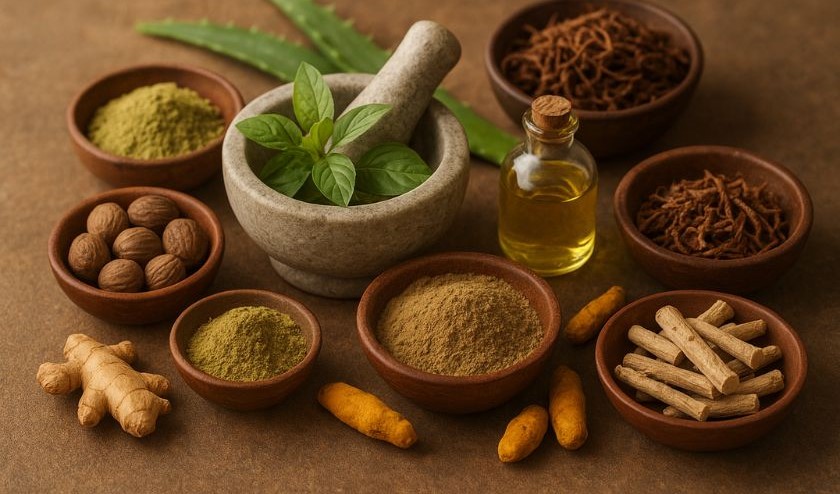
Several classical Ayurvedic herbs are employed to restore reproductive health in PCOS-associated infertility:
- Trikatu (Zingiber officinale, Piper nigrum, Piper longum) is widely used for its Deepana and Pachana properties, enhancing metabolism and reducing Ama accumulation.
- Ashwagandha (Withania somnifera) improves endocrine balance, reduces stress-induced hormonal disruption, and enhances ovarian function through adaptogenic effects.
- Guduchi (Tinospora cordifolia) acts as an immunomodulator and insulin-sensitizing agent, improving metabolic dysfunction associated with PCOS.
- Shatavari (Asparagus racemosus) supports follicular development and improves uterine receptivity through its Rasayana and phytoestrogenic actions.
- Kanchanar Guggulu is commonly used to reduce cystic ovarian enlargement and correct lymphatic congestion through its Lekhana and Kapha-shamaka properties.
- Triphala formulations aid in detoxification, improve gut health, and reduce systemic inflammation, indirectly supporting hormonal balance.
Panchakarma and detoxification therapies
Detoxification procedures play a central role in restoring fertility by eliminating Ama and correcting metabolic dysfunction:
- Vamana is indicated in severe Kapha dominance.
- Virechana helps in regulating Pitta and improving hormonal metabolism.
- Basti (medicated enema) is considered the most important therapy for Vata-related reproductive disorders and is highly effective in restoring ovulatory cycles.
These therapies enhance Srotas patency, improve ovarian response, and support natural conception.
Lifestyle and dietary modifications
Ayurveda emphasizes lifestyle correction as a cornerstone of PCOS management. Regular physical activity, yoga, and stress reduction techniques such as pranayama are recommended to restore hormonal balance. Dietary regulation includes avoidance of heavy, oily, and processed foods, while favoring light, warm, and easily digestible meals that enhance Agni. These interventions help in reducing obesity, insulin resistance, and metabolic inflammation.
Reproductive outcomes and therapeutic rationale
Improvement in ovulation, menstrual regularity, and endometrial receptivity has been observed with integrated Ayurvedic management strategies. By addressing root pathological mechanisms—Kapha accumulation, Vata imbalance, and Ama formation—Ayurveda aims to restore physiological fertility rather than merely inducing ovulation.
Conclusion
Ayurvedic management of PCOS-associated infertility offers a comprehensive and individualized therapeutic framework that integrates herbal medicine, detoxification procedures, and lifestyle regulation. By targeting metabolic dysfunction, hormonal imbalance, and reproductive channel obstruction, Ayurveda provides a holistic pathway toward restoring fertility. While preliminary clinical observations are promising, further large-scale, well-designed studies are needed to validate efficacy and standardize treatment protocols in modern reproductive medicine.2
References:
- Rathi I, Mavi A, Shannawaz M, Saeed S, Yadav A, Hasan S. Effectiveness of Ayurveda Intervention in the Management of Infertility: A Systematic Review. Cureus. 2024;16(4):e57730. Published 2024 Apr 6. doi:10.7759/cureus.57730 https://pmc.ncbi.nlm.nih.gov/articles/PMC11073818/
- Asmabi MA, Jithesh MK. Ayurveda management of infertility associated with Poly Cystic Ovarian Syndrome: A case report. J Ayurveda Integr Med. 2022;13(2):100513. doi:10.1016/j.jaim.2021.08.006 https://pmc.ncbi.nlm.nih.gov/articles/PMC8814398/#sec7