
Introduction
Primary intestinal motility disorders, including functional gastrointestinal disorders (FGIDs), are complex conditions characterized by impaired gut motility without consistently identifiable structural or biochemical abnormalities. Patients typically present with intermittent crampy abdominal pain, bloating, dyspepsia, nausea, and altered bowel habits. In more severe cases, symptoms may be persistent and disabling, often accompanied by extra-intestinal manifestations such as fatigue, headache, musculoskeletal pain, dizziness, and significant psychiatric comorbidities. These overlapping gastrointestinal and systemic features highlight the multifactorial and biopsychosocial nature of gut dysmotility disorders.1
Irritable bowel syndrome: Clinical burden and diagnostic framework
Irritable bowel syndrome (IBS) represents the most prevalent FGID and is defined by recurrent abdominal pain associated with altered bowel habits. It accounts for a substantial proportion of gastroenterology consultations globally and is diagnosed primarily based on symptom-based criteria, as no definitive biomarker exists. IBS continues to impose a major healthcare burden due to its chronicity, symptom variability, and impact on quality of life.
Pathophysiology: Gut-immune-microbiota interactions
The pathophysiology of IBS is increasingly understood as a dynamic interaction between luminal factors (dietary components and gut microbiota), epithelial barrier integrity, and mucosal immune activation. Immune dysregulation, particularly mast cell activation, leads to the release of inflammatory mediators such as histamine, proteases, and prostaglandins. These mediators increase intestinal permeability and sensitize enteric neurons, contributing to visceral hypersensitivity, pain perception, and altered motility patterns. This complex network forms the basis for emerging microbiome-targeted and phytotherapeutic interventions.
Role of complementary and herbal therapies in IBS
Given its heterogeneous mechanisms, patients with IBS frequently adopt dietary modifications, probiotics, prebiotics, and herbal therapies for symptom relief. Phytotherapeutic agents are gaining increasing attention due to their multitarget effects on gut motility, inflammation, microbiota composition, and visceral sensitivity. However, despite widespread use, many alternative treatments still require stronger scientific validation through controlled clinical studies.
Triphala: Composition and phytochemical profile
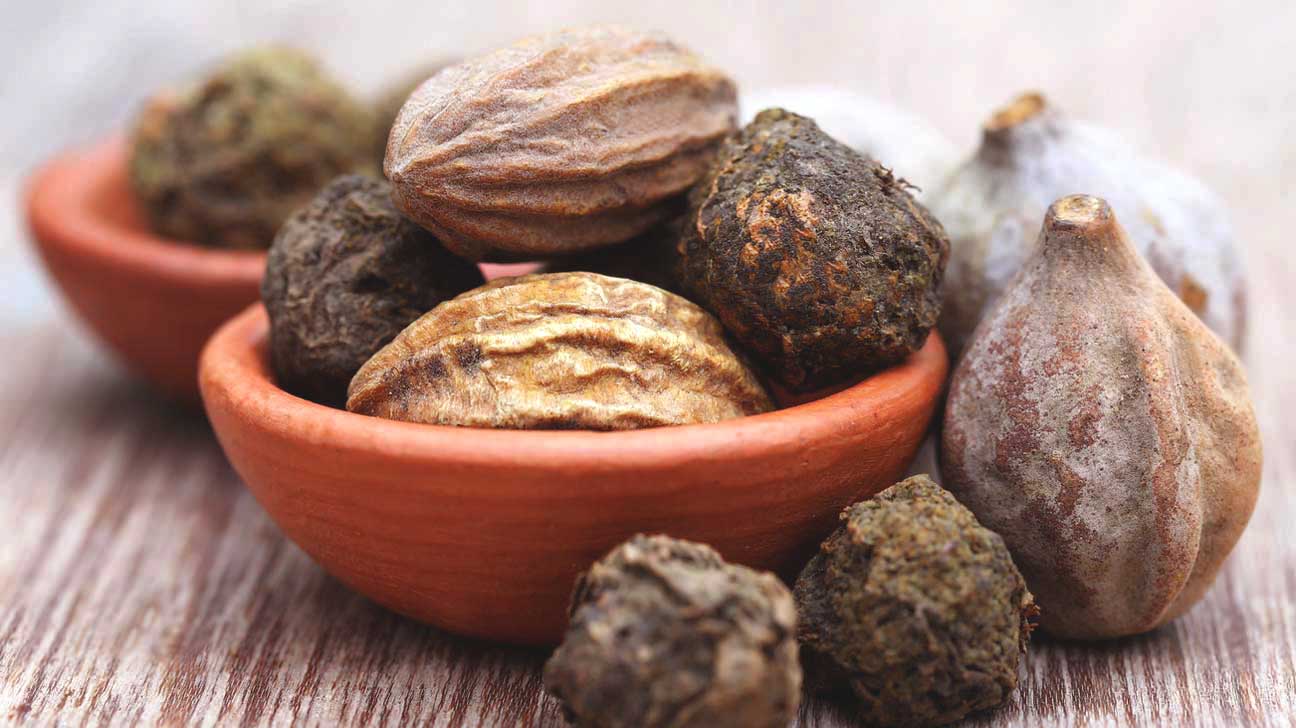
- Triphala (TLP) is a classical Ayurvedic polyherbal formulation composed of equal parts dried fruits of Terminalia chebula, Terminalia bellerica, and Phyllanthus emblica. Its therapeutic potential is largely attributed to a rich phytochemical spectrum including tannins, polyphenols, flavonoids, vitamin C, and phytosterols.
- Key bioactive constituents such as gallic acid, chebulic acid, ellagic acid, chebulinic acid, epicatechin, and ascorbic acid contribute significantly to its biological effects. Each component plant adds distinct pharmacological value, ranging from antioxidant and antimicrobial activity to lipid-modulating and cytoprotective effects.2
Mechanisms of action: Antioxidant, anti-inflammatory, and immunomodulatory effects
Triphala exhibits broad pharmacological actions relevant to FGIDs. Its antioxidant activity is mediated through scavenging of reactive oxygen species, enhancement of endogenous antioxidant enzymes (SOD, CAT, GPx), and reduction of lipid peroxidation. Immunomodulatory effects include downregulation of pro-inflammatory cytokines such as TNF-α and IL-6 via inhibition of NF-κB signaling pathways. Additionally, Triphala modulates macrophage and lymphocyte responses, thereby reducing mucosal inflammation and improving epithelial barrier integrity.
Effects on gut motility and microbiota regulation
Triphala exhibits bidirectional effects on gastrointestinal motility depending on formulation and physiological context. Certain constituents demonstrate prokinetic and laxative properties, while others exert antidiarrheal and spasmolytic effects. Mechanistically, modulation of muscarinic receptors, enteric neurotransmission, and smooth muscle activity has been proposed. Importantly, Triphala influences gut microbiota composition by promoting beneficial bacteria such as Bifidobacterium and Lactobacillus while suppressing pathogenic organisms. Its polyphenols are metabolized into bioactive compounds like urolithins, which further contribute to anti-inflammatory activity in the gut environment.3
Clinical evidence and safety profile
Clinical evidence suggests potential benefits of Triphala in functional constipation and mild gastrointestinal dysfunction, including improvements in stool frequency, consistency, and abdominal discomfort. Toxicity studies indicate a favorable safety profile at therapeutic doses, although variability in formulation and dosing remains a limitation. Standardization of preparations is essential for reproducible clinical outcomes.
Conclusion
Triphala represents a multi-component Ayurvedic formulation with significant therapeutic potential in functional gastrointestinal disorders, including IBS. Its efficacy is driven by combined antioxidant, anti-inflammatory, immunomodulatory, antimicrobial, and microbiota-modulating actions. While preclinical and early clinical findings are promising, well-designed randomized controlled trials are needed to establish its definitive role in IBS management and to support its integration into evidence-based clinical practice.4
References:
- Mearin F, Malfertheiner P. Functional Gastrointestinal Disorders: Complex Treatments for Complex Pathophysiological Mechanisms. Dig Dis. 2017;35 Suppl 1(1):1-4. doi:10.1159/000485407 https://pmc.ncbi.nlm.nih.gov/articles/PMC6067652/
- Peterson CT, Denniston K, Chopra D. Therapeutic Uses of Triphala in Ayurvedic Medicine. J Altern Complement Med. 2017;23(8):607-614. doi:10.1089/acm.2017.0083 https://pmc.ncbi.nlm.nih.gov/articles/PMC5567597/
- Tarasiuk A, Mosińska P, Fichna J. Triphala: current applications and new perspectives on the treatment of functional gastrointestinal disorders. Chin Med. 2018;13:39. Published 2018 Jul 18. doi:10.1186/s13020-018-0197-6 https://pmc.ncbi.nlm.nih.gov/articles/PMC6052535/
- Ahmed S, Ding X, Sharma A. Exploring scientific validation of Triphala Rasayana in ayurveda as a source of rejuvenation for contemporary healthcare: An update. J Ethnopharmacol. 2021;273:113829. doi:10.1016/j.jep.2021.113829 https://www.sciencedirect.com/science/article/abs/pii/S0378874121000556?via%3Dihub