
Introduction
Global context and herbal medicine use:
Only a small fraction of the estimated 3,00,000 plant species worldwide has been scientifically evaluated for therapeutic use. Herbal medicines are widely perceived as safe and natural, which has contributed to their global acceptance. During the COVID-19 pandemic, traditional medical systems gained renewed attention due to the absence of definitive antiviral therapies and the reported immunomodulatory and anti-inflammatory potential of herbal interventions.
Ayurveda and AYUSH framework:
India possesses a well-established traditional healthcare system under AYUSH, encompassing Ayurveda, Yoga, Unani, Siddha, Homeopathy, and other indigenous practices.1 The Ministry of AYUSH has actively promoted research, education, and clinical evaluation of traditional formulations, including those used for immune support during the pandemic period.
Emergence of safety concerns regarding guduchi:
A case series reported by Nagral et al. described patients developing drug-induced autoimmune-like hepatitis following consumption of Guduchi (Tinospora cordifolia). Guduchi, a widely used Ayurvedic Rasayana, is traditionally regarded as hepatoprotective and immunomodulatory. This apparent contradiction necessitates a critical evaluation of its safety profile, pharmacological identity, and clinical usage patterns.
Historical and traditional usage
Classical Ayurvedic documentation:
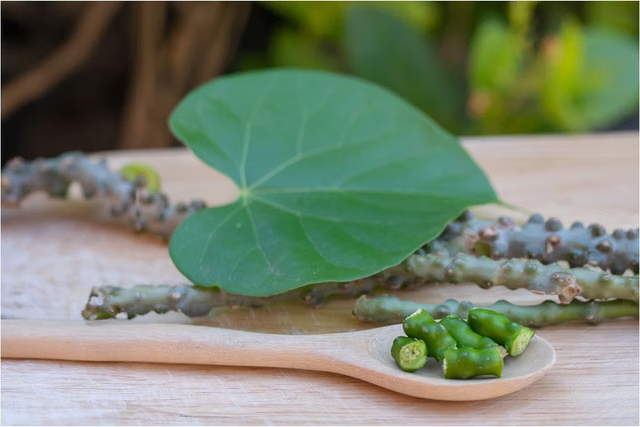
Tinospora cordifolia (Guduchi/Amrita) has been extensively described in classical Ayurvedic texts dating back to ancient treatises. It is traditionally considered a potent Rasayana, valued for promoting longevity, vitality, and disease resistance.
Therapeutic indications in Ayurveda:
Guduchi is indicated in multiple disorders including fever (Jvara), respiratory diseases (Svasa), anorexia (Aruchi), metabolic disorders, jaundice (Kamala), and inflammatory conditions. It is widely referenced in Charaka Samhita, Sushruta Samhita, and Ashtanga Hridaya for its broad therapeutic utility.
Ayurvedic pharmacodynamic profile
Guduchi exhibits:
- Taste (Rasa): Bitter (Tikta) and Astringent (Kashaya)
- Properties (Guna): Light (Laghu)
- Potency (Virya): Hot (Ushna)
- Post-digestive effect (Vipaka): Sweet (Madhura)
- Actions (Karma): Balya (Imparts Strength/immune modulator), Dipana (digestive), Rasayana (enhances life), Tridoshahara (pacifies all doshas), Raktashodaka (purifies blood), Jvaragna (antipyretic)
Traditional dosage forms:
Guduchi is used in multiple formulations such as swarasa, kwatha, churna, satwa, ghrita preparations, and polyherbal combinations including Kaishor Guggulu and Chandraprabha Vati. These diverse preparations reflect its wide therapeutic applicability in Ayurvedic practice.
Botanical identity and trade considerations
Commercial availability and substitution risk:
Guduchi is one of the most widely traded medicinal plants in India. However, adulteration and substitution with species such as Tinospora sinensis and Tinospora crispa have been reported due to morphological similarity of stems in dried form.
Importance of authentication:
Studies using DNA barcoding and phytochemical analysis indicate that a proportion of market samples labeled as Guduchi may not be authentic Tinospora cordifolia. This raises significant concerns regarding safety, efficacy, and reproducibility of clinical outcomes.
Morphological characteristics of Tinospora cordifolia and its substitutes and adulterants:
|
Morphological characters |
Tinospora cordifolia |
Tinospora sinensis |
Tinospora crispa |
|
Leaves |
Broadly ovate-cordate, glabrous, domatia usually present on lower surface, membranous |
Ovate to suborbicular, pubescent above and pilose beneath, domatia usually absent |
Broadly ovate to oblong-orbicular, glabrous, domatia absent |
|
Flowers |
Petals 6; male flowers on ~5 mm long pedicels |
Petals 6; male flowers on ~5 mm long pedicels |
Petals usually 3; male flowers on ~10 mm long pedicels |
|
Fruit (drupe) |
Globose, red when ripe |
Globose, scarlet to orange-red when ripe |
Ellipsoid, orange when ripe |
|
Stem |
Not tuberculated, glabrous |
Not tuberculated, young stems hairy |
Strongly tuberculated, glabrous |
|
Distribution |
India, Sri Lanka, Bangladesh, Myanmar |
India, Sri Lanka, Bangladesh, Nepal, Myanmar, China, Thailand, Cambodia |
Eastern India, China, Cambodia, Thailand, Malaysia, Java, Philippines |
|
Sap |
Watery |
Watery |
Milky |
Phytoconstituents
Major bioactive compounds:
Tinospora cordifolia contains a wide range of phytochemicals including2:
- Alkaloids (berberine, magnoflorine, palmatine)
- Diterpenoid lactones (tinosporin, cordifolide derivatives)
- Glycosides (tinocordiside, cordioside)
- Sterols (β-sitosterol)
- Polysaccharides (arabinogalactan complexes)
Comparative phytochemistry:
While T. cordifolia shares partial similarity with T. sinensis, significant differences exist compared with T. crispa, which contains distinct flavonoids, lignans, and alkaloids that may influence biological activity and safety profiles.
Pharmacology and toxicology
Antioxidant and anti-inflammatory activity:
Extracts of T. cordifolia demonstrate significant free radical scavenging activity and inhibition of oxidative stress pathways. Experimental models also show suppression of COX and LOX-mediated inflammatory responses, supporting its anti-inflammatory and antipyretic potential.
Immunomodulatory effects:
Guduchi enhances both innate and adaptive immune responses through polysaccharide-mediated activation of cytokine pathways. Clinical studies suggest improved vaccine response and increased immunological markers such as GM-CSF.
Antiviral potential:
Experimental evidence indicates antiviral activity through modulation of host immune responses and inhibition of viral replication pathways. However, clinical validation remains limited.
Hepatoprotective activity:
Guduchi is traditionally indicated for liver disorders such as Kamala (jaundice). Experimental studies demonstrate reduction in liver enzymes (ALT, AST, ALP) and protection against chemically induced hepatotoxicity. Clinical observations also suggest improvement in liver function parameters in hepatic disorders.
Toxicological profile:
T. cordifolia has shown a wide safety margin in animal and human studies, with no consistent evidence of inherent hepatotoxicity. In contrast, T. crispa has been associated with reported cases of hepatotoxicity, raising concerns regarding adulteration-related adverse events.
Discussion
Interpretation of reported hepatotoxicity:
The reported cases of liver injury attributed to Guduchi may not conclusively establish causality with authentic Tinospora cordifolia. Lack of botanical authentication and possible substitution with hepatotoxic species such as T. crispa represent major confounding factors.
Methodological limitations in reported case series:
Key limitations include absence of verified plant identity, incomplete exposure history, and presence of comorbid conditions and concurrent medications. These factors limit causal attribution and interpretation of hepatotoxic risk.
Adulteration and quality control concerns:
Herbal medicine markets are vulnerable to substitution and adulteration due to morphological similarity, supply chain variability, and insufficient regulatory enforcement. Such issues may lead to misclassification of adverse events as drug-related toxicity.
Clinical and regulatory implications:
The evidence suggests that adverse hepatic outcomes may be linked more to product quality and species misidentification rather than intrinsic toxicity of T. cordifolia. Strengthening pharmacovigilance, authentication methods, and regulatory oversight is essential.
Conclusion
Current evidence does not provide definitive support for intrinsic hepatotoxicity of authentic Tinospora cordifolia (Guduchi). Reported cases of liver injury may be confounded by adulteration, misidentification, and inadequate clinical documentation. Robust pharmacovigilance systems, botanical authentication, and well-designed clinical studies are necessary to ensure safety and clarify the true hepatic risk profile of Guduchi.3
References:
- Nesari T, Nesari M, Ruknuddin G, et al. India's journey in mainstreaming Ayush in primary health care-from tradition to integration. Front Med (Lausanne). 2025;12:1629515. Published 2025 Oct 28. doi:10.3389/fmed.2025.1629515. https://pmc.ncbi.nlm.nih.gov/articles/PMC12602521/
- Chaudhary A, Das R, Mehta K, Mehta DK. Indian herb Tinospora cordifolia and Tinospora species: Phytochemical and therapeutic application. Heliyon. 2024;10(10):e31229. Published 2024 May 16. doi:10.1016/j.heliyon.2024.e31229. https://pmc.ncbi.nlm.nih.gov/articles/PMC11133831/
- Panneer Selvam K, Payyappallimana U, Ravikumar K, Venkatasubramanian P. Can Guduchi (Tinospora cordifolia), a well-known ayurvedic hepato-protectant cause liver damage?. J Ayurveda Integr Med. 2023;14(1):100658. doi:10.1016/j.jaim.2022.100658. https://pmc.ncbi.nlm.nih.gov/articles/PMC10105241/