
Introduction
Ayurveda, meaning “the science of life,” is a traditional Indian system of medicine that emphasizes disease prevention, health promotion, and individualized treatment based on an individual’s constitution (Prakriti). Rooted in classical texts such as the Charaka Samhita, Sushruta Samhita, and Ashtanga Hridaya, Ayurveda aims to maintain harmony among the body, mind, and spirit through diet, lifestyle modification, herbal medicines, and therapeutic interventions. Its theoretical framework is based on the Panchamahabhutas (five elements) and the Tridosha system—Vata, Pitta, and Kapha—which govern physiological and pathological processes.
A distinctive feature of Ayurveda is its use of polyherbal formulations, where multiple medicinal plants are combined to achieve synergistic therapeutic effects while minimizing adverse reactions. In addition to herbal therapies, Ayurveda incorporates specialized modalities such as Panchakarma (detoxification), Rasayana (rejuvenation therapy), and Satvavajaya (psychological management) to support holistic health. Growing scientific evidence has contributed to the integration of Ayurvedic principles into complementary and integrative healthcare systems.
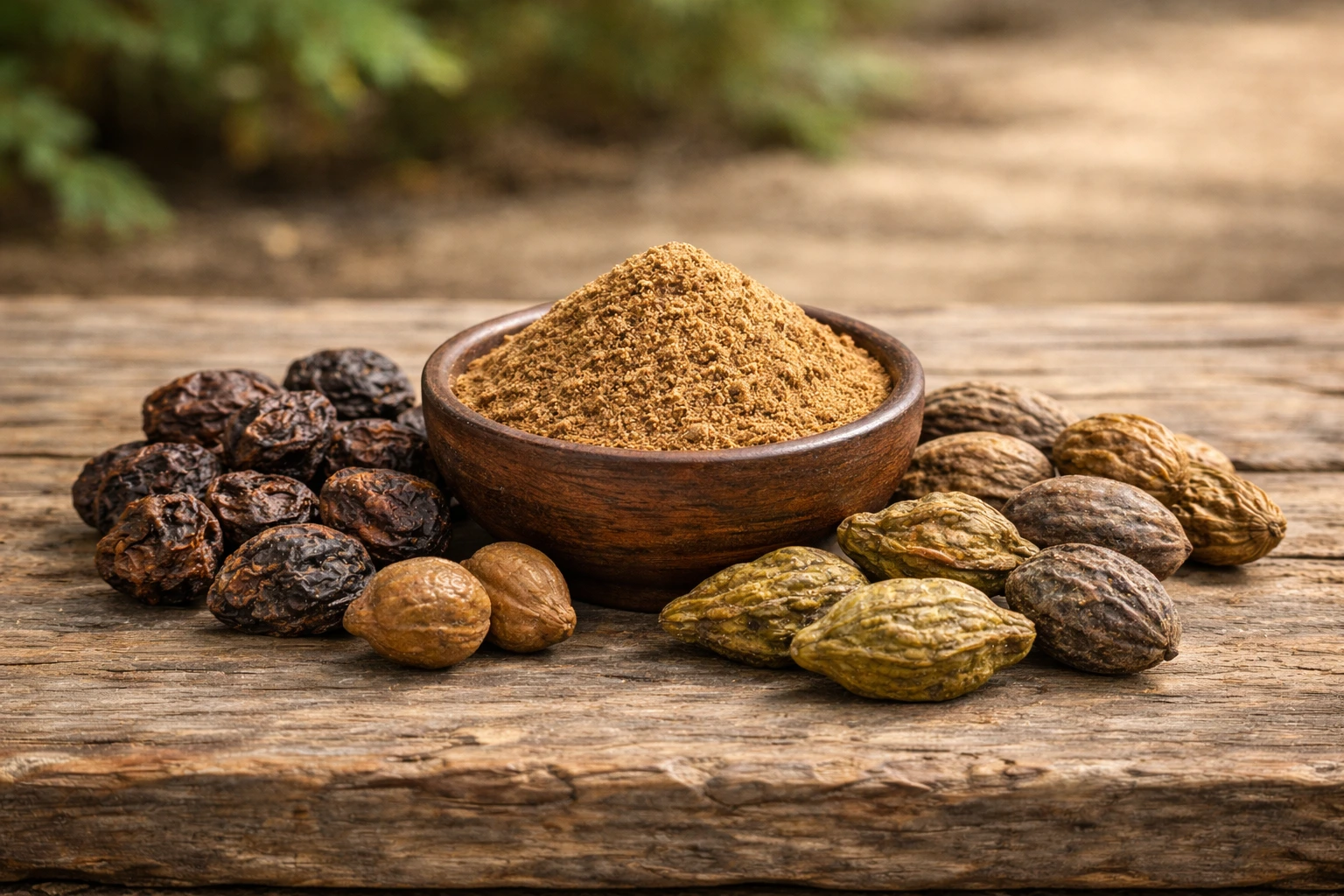
Among the most widely used Ayurvedic formulations is Triphala, a classical polyherbal preparation composed of the dried fruits of Emblica officinalis (Amalaki), Terminalia bellirica (Bibhitaki), and Terminalia chebula (Haritaki) in equal proportions. Recognized as a Tridoshic Rasayana, Triphala has been traditionally used for promoting longevity, maintaining digestive health, and enhancing overall well-being. Classical Ayurvedic literature regards Triphala as a potent rejuvenative formulation with broad therapeutic applications.
The pharmacological activities of Triphala are attributed to its rich phytochemical composition, including vitamin C, hydrolyzable tannins, gallic acid, ellagic acid, chebulagic acid, corilagin, flavonoids, and other polyphenolic compounds. These bioactive constituents exhibit antioxidant, anti-inflammatory, immunomodulatory, antimicrobial, hepatoprotective, and metabolic regulatory properties. Contemporary studies have further demonstrated its potential benefits in gastrointestinal disorders, metabolic syndrome, cardiovascular health, oral care, neuroprotection, and cancer prevention.
Properties and effects of every constituent of Triphala
|
Constituents |
Properties |
|
Amalaki (Amla) |
Emblica officinalis (Indian gooseberry) is a potent herb with dry and heavy qualities that helps balance Pitta dosha by cooling body heat and supporting digestion and metabolism. It is rich in rejuvenating properties, improving hair health, skin quality, vision, and memory. It supports sensory functions, promotes healthy bowel movements, and acts as an expectorant and bronchodilator in respiratory conditions. It also aids in infertility management and overall rejuvenation. |
|
Haritaki (Harad) |
Terminalia chebula (Haritaki) is an important Ayurvedic herb with a complex taste profile containing five of six tastes, predominantly astringent, with sweet post-digestive effect and warm potency. Its light and dry qualities help balance all three doshas, especially Vata. It acts as a Rasayana with benefits in skin healing, CNS disorders, respiratory inflammation, gastrointestinal issues (indigestion, hemorrhoids), liver and spleen disorders, and metabolic support. It also functions as a mild laxative, detoxifier, and enhancer of fertility and renal health. |
|
Bibhitaki (Baheda) |
Terminalia bellerica (Bibhitaki) has bitter, astringent, and sweet tastes with warming potency. Its light and dry qualities support digestive and respiratory health. It has detoxifying, anti-inflammatory, and antimicrobial properties. It is traditionally used for Kapha-related disorders, including hair greying, skin disorders, insomnia, vision issues (blindness, myopia), neurological conditions, and blood disorders like hemoptysis. It also supports gastrointestinal health (vomiting, nausea, anorexia, helminthiasis) and is considered a libido enhancer. |
Variations in Triphala and their specific uses according to Ayurveda
|
Variety of Triphala |
Making methods and their specific uses |
|
Triphala churna (Powder) |
It is made by taking haritaki, bibhitaki, and amla and finely grinding in the ratio of 1:1:1 or 1:2:4 as needed. It is suggested to be consumed with ghee (clarified butter), milk, or honey for maximum benefits. |
|
Triphala kwatha (Decoction) |
Kwatha is made by taking Triphala churna and water in a 1:16 ratio and boiling until the water is half evaporated; then, this decoction is strained using a sieve or cloth. This decoction is used in cellulite, worm infections, and urine-related disorders. A decoction is a washing agent for eyes and open wounds and gargling during pharynx inflammation, causing a sore throat. |
|
Triphala taila (oil) |
Triphala tail is an ayurvedic medicinal oil form of Triphala prepared through control heating infusion of Triphala powder in coconut oil or sesame oil. This versatile oil is utilized in diverse therapeutic applications, including gargling, topical application, snuffing, enema, and oral consumption, to address various health concerns such as obesity, stress, and itching. |
|
Triphala masi (ash) |
The production of Triphala Masi involves heating Triphala powder in an iron vessel within a controlled environment, maintaining temperatures below 450°C. This process yields Masi, a transitional product containing organic and inorganic components. When heated further above 450°C, Masi transforms into Bhasma, a pure white ash. When making masi, thermal degradation happens at higher temperatures, and then raw material and heat are lost, creating unstable compounds. Due to the high amount of carbon, it is black. It can be combined with honey or sesame oil and applied externally to promote wound healing. It is also used as an ingredient in toothpaste to treat dental disorders like Pyorrhea and tooth loss. |
|
Triphala gritha (in ghee or clarified butter) |
Mix Triphala paste and Trikatu (long pepper, black pepper, and ginger) in a ratio of 3:1 in ghee or milk, and cook this for a long time. It is commonly used in treating disorders related to the eyes, such as conjunctivitis, blindness, cataracts, and jaundice, and it prevents premature hair greying, hair loss, and tumors. |
Properties of Triphala
Antimicrobial activity:
Triphala exhibits broad-spectrum antimicrobial activity against Gram-positive and Gram-negative bacteria due to its high tannin and phenolic content. Both aqueous and alcoholic extracts inhibit pathogens such as Staphylococcus aureus, Pseudomonas aeruginosa, Vibrio cholerae, and antibiotic-resistant clinical isolates. It is effective against urinary tract and wound pathogens, with enhanced activity noted in Triphala churna compared to mashi in some studies. Triphala mouthwash has also shown significant reduction of Streptococcus mutans, with efficacy comparable to chlorhexidine, suggesting its potential as a natural antimicrobial agent.
Antioxidant activity:
Triphala demonstrates strong free radical scavenging activity by enhancing endogenous antioxidant defenses, including superoxide dismutase (SOD), catalase (CAT), glutathione peroxidase (GPx), and glutathione (GSH). It reduces oxidative stress–induced damage in experimental models, including radiation, noise stress, and drug-induced toxicity. It also inhibits lipid peroxidation and xanthine oxidase activity, supporting radioprotective, neuroprotective, and anti-cataract effects. Its polyphenols, flavonoids, and triterpenoids contribute to overall antioxidant efficacy and cytoprotective potential.
Anti-inflammatory activity:
Triphala suppresses inflammatory pathways by inhibiting NF-κB activation and reducing pro-inflammatory mediators such as TNF-α, IL-1β, COX-2, and PGE2. In experimental arthritis models, it significantly reduces paw edema, lipid peroxidation, lysosomal enzymes, and glycoprotein levels. Its anti-inflammatory efficacy is comparable to standard NSAIDs like indomethacin, with additional antioxidant benefits. It also demonstrates protective effects in ocular inflammation and endotoxin-induced uveitis.
Wound healing activity:
Triphala enhances wound repair by promoting collagen synthesis, increasing extracellular matrix components, and reducing microbial load. It accelerates granulation tissue formation and improves wound contraction. Formulations such as Triphala ointment, collagen-based dressings, and alcoholic extracts show improved tissue regeneration, reduced inflammation, and inhibition of wound pathogens.
Anticataract activity:
Triphala delays cataract progression by reducing oxidative stress and lipid peroxidation in lens tissue. It enhances antioxidant enzyme activity while preventing protein aggregation and lens opacity in experimental cataract models. Both aqueous extracts and Triphala Ghrita formulations demonstrate dose-dependent protection, with improved bioavailability enhancing therapeutic effects.
Antidiabetic effects:
Triphala exhibits significant antihyperglycemic activity in alloxan- and fructose-induced diabetic models. Oral administration reduces blood glucose levels, improves glucose tolerance, and shows sustained glycemic control with repeated dosing. Its antidiabetic action is mediated through inhibition of α-amylase and α-glucosidase, reducing postprandial glucose absorption. Phenolic and flavonoid constituents also contribute via antioxidant mechanisms that limit lipid peroxidation and oxidative stress. Clinical and experimental studies indicate improved insulin secretion and glycemic regulation, potentially through incretin/cAMP signaling involving GLP-1, GIP, and downstream Akt and PKA pathways. Long-term use demonstrates potential to reduce glycation and insulin dependence in type 2 diabetes.
Cardioprotective and lipid-lowering effects:
Triphala shows cardioprotective activity through antioxidant, anti-lipid peroxidative, and hypolipidemic mechanisms. It improves lipid profiles by reducing total cholesterol, LDL, VLDL, triglycerides, and free fatty acids while increasing HDL. Experimental studies demonstrate reduced myocardial injury markers (CK-MB, MDA) and improved antioxidant status (GSH, SOD). It also attenuates atherosclerotic progression by inhibiting lipid peroxidation and improving endothelial function. Key constituents such as Emblica officinalis and Terminalia bellerica enhance cardiac function and hemodynamic stability. Bioactive compounds modulate cardiovascular-related genes and signaling pathways involved in inflammation and oxidative stress.
Anticancer effects:
Triphala exhibits broad-spectrum antineoplastic activity against breast, cervical, pancreatic, ovarian, colon, and melanoma cell lines. It induces apoptosis, inhibits proliferation, and suppresses metastasis via modulation of NF-κB, PI3K/Akt, MAPK/ERK, and Wnt signaling pathways. Mechanistically, it disrupts microtubule dynamics and tubulin polymerization, leading to cell cycle arrest and programmed cell death. Chebulinic acid and gallic acid are key cytotoxic constituents contributing to ROS-mediated cancer cell death while sparing normal cells. Triphala also inhibits angiogenesis by downregulating VEGF/VEGFR2 signaling and enhances immune-mediated tumor suppression via NK cell activation. Experimental models confirm significant tumor growth inhibition, including xenograft studies.
Anti-obesity effects:
Triphala reduces body weight gain, adiposity, and dyslipidemia in high-fat diet models. It improves insulin sensitivity and increases HDL while reducing triglycerides, cholesterol, and inflammatory markers. Molecular studies show downregulation of lipogenic genes including SREBP-1c, PPAR-γ, ACC, and FASN. It also modulates gut–brain signaling by restoring dopamine and serotonin levels, suggesting appetite regulation. Metabolomic studies indicate gut microbiota–mediated metabolic reprogramming, supporting its role in energy homeostasis and obesity management.
Hepatoprotective effects:
Triphala protects against chemical- and diet-induced hepatic injury by reducing oxidative stress, inflammation, and lipid accumulation. It normalizes liver enzymes (ALT, AST, ALP) and restores antioxidant defenses (GSH, SOD, CAT, GPx). Histological studies confirm reduced hepatocellular damage. Its bioactive compounds, including gallic acid and chebulinic acid, inhibit NAFLD progression by modulating lipid metabolism and gut–liver axis interactions. Dose-dependent hepatoprotection is comparable to standard drugs in experimental models.
Neuroprotective effects:
Triphala improves cognitive function and reduces neuroinflammation in Alzheimer’s and stress-induced neurodegeneration models. It reduces amyloid deposition, modulates APP processing, and restores gut–brain axis balance. It enhances antioxidant defenses and activates Nrf2/HO-1 signaling, reducing oxidative neuronal damage. Triphala also regulates neurotransmitters (5-HT, BDNF) and improves stress resilience. These effects are linked to modulation of microbiota composition and inflammatory pathways, indicating potential in neurodegenerative and psychiatric disorders.
Immunomodulatory effects:
Triphala modulates both innate and adaptive immunity by enhancing macrophage phagocytosis, NK cell activity, and T-lymphocyte responses. It regulates cytokines including TNF-α, IL-1β, and IL-6, while suppressing COX-2-mediated inflammation. Phytoconstituents such as flavonoids, tannins, and phenolics contribute to immune regulation. Experimental evidence shows improved cell-mediated immunity and enhanced nonspecific immune responses, supporting its role as an immunomodulator.
Gastroprotective effects:
Triphala supports gastrointestinal health by modulating gut microbiota, promoting beneficial bacteria (Lactobacillus, Bifidobacterium), and inhibiting pathogenic organisms. It enhances mucosal defense, increases antioxidant enzymes, and reduces gastric ulceration and lipid peroxidation. Its polyphenols are metabolized into bioactive urolithins that reduce intestinal inflammation and oxidative damage. Experimental models confirm protection against NSAID-induced gastric injury.
Radioprotective effects:
Triphala protects against radiation-induced DNA damage by scavenging reactive oxygen species and reducing lipid peroxidation. It restores antioxidant enzyme levels (SOD, CAT, GSH) and decreases xanthine oxidase activity. Pre- and post-radiation administration reduces mortality and chromosomal damage in experimental models. Phenolic compounds, especially gallic acid, are primarily responsible for its radioprotective action.
Conclusion
Triphala is a multi-targeted polyherbal formulation with validated antioxidant, anti-inflammatory, antidiabetic, cardioprotective, hepatoprotective, neuroprotective, anticancer, immunomodulatory, and gastroprotective activities. Its pharmacological effects are mediated through oxidative stress modulation, enzyme inhibition, and regulation of key cellular signaling pathways. Despite strong preclinical evidence, further clinical validation, pharmacokinetic profiling, and standardized formulations are required for its integration into evidence-based therapeutics.
References:
- Bairwa VK, Kashyap AK, Meena P, Jain BP. Triphala's characteristics and potential therapeutic uses in modern health. Int J Physiol Pathophysiol Pharmacol. 2025;17(2):19-36. Published 2025 Apr 25. doi:10.62347/OBSS5026. https://pmc.ncbi.nlm.nih.gov/articles/PMC12089839/