
Introduction
India possesses a rich heritage of traditional medical systems, with Ayurveda being one of the oldest and most extensively practiced. Ayurveda emphasizes not only the treatment of diseases but also their prevention and overall optimization of health and vitality. Central to Ayurvedic philosophy are preventive strategies and a deeper understanding of disease causation, aiming to restore balance among the three doshas-Vata, Pitta, and Kapha. Classical Ayurvedic texts such as the Charaka Samhita and Sushruta Samhita describe more than 700 medicinal herbs and 8000 formulations, many of which are now being revisited in the context of gut microbiome research and modern therapeutic science.
Ayurvedic perspective on gut health and disease prevention
In Ayurveda, gastrointestinal health is considered the foundation of systemic well-being.
- Impairment of digestive capacity (Agni) leads to the accumulation of metabolic toxins (Ama), which is conceptually aligned with modern understandings of dysbiosis, impaired barrier function, and systemic inflammation.
- The Ayurvedic framework integrates preventive and curative approaches, emphasizing dietary regulation, herbal medicine, and lifestyle optimization to maintain gut homeostasis and prevent disease onset.
Medicinal plants and gut microbiome modulation
A wide range of Ayurvedic medicinal plants are traditionally classified as medicinal-food homologs and are known for their anti-inflammatory, antacid, anti-ulcer, and digestive regulatory properties.
- These include Acacia species (Gum Arabic), Curcuma longa (Haridra), Withania somnifera (Ashwagandha), Aloe vera (Ghrit kumari), Ocimum sanctum (Tulsi), Terminalia chebula (Haritaki), Terminalia bellirica (Baheda), and Emblica officinalis (Amla).
- Recent evidence suggests that these botanicals influence gut microbial composition by promoting beneficial bacteria such as Bifidobacterium and Lactobacillus, while suppressing pathogenic organisms, thereby contributing to restoration of microbial balance and improvement of gastrointestinal health.
Prebiotic and microbiome-modulating effects of key Ayurvedic plants
Gum Arabic (Acacia spp.):
- Gum Arabic, derived from Acacia species, has demonstrated significant prebiotic properties in human studies. Supplementation (10 g/day) has been shown to significantly increase Bifidobacteria, Lactobacilli, and Bacteroides populations, along with enhanced production of short-chain fatty acids (SCFAs) such as acetate, propionate, and butyrate.
- These microbial shifts support intestinal integrity and metabolic regulation, without promoting pathogenic overgrowth, highlighting its potential as a functional dietary fiber for gut health.
Curcuma longa (Haridra/ Turmeric):
- Turmeric has been extensively studied for its gastrointestinal protective and microbiome-modulating effects.
- Curcumin has been shown to increase microbial diversity and influence multiple bacterial taxa while exerting anti-inflammatory effects via NF-κB and TNF-α inhibition.
- Clinical studies indicate its potential benefit in IBS, IBD, and gastritis. Additionally, turmeric enhances gastric mucus secretion and reduces ulcer formation, supporting mucosal defense mechanisms.
Withania somnifera (Ashwagandha):
- Ashwagandha exhibits stress-modulating and immunoregulatory effects, with emerging evidence suggesting indirect modulation of gut microbiota.
- Animal studies indicate improved gut microbial balance with reduced pathogenic bacteria and enhanced beneficial flora, suggesting a gut–brain–microbiome interaction in stress-related disorders.
Aloe vera (Ghrit kumari):
- Aloe vera polysaccharides enhance gut microbial fermentation and increase SCFA production. Experimental models demonstrate improvement in colonic mucosal integrity, increased mucin expression (MUC2 and MUC5AC), and anti-inflammatory effects in ulcerative colitis models.
- These properties contribute to gut barrier protection and microbial homeostasis.
Ocimum sanctum (Tulsi):
- Tulsi exhibits anti-ulcer, anti-inflammatory, and antimicrobial effects.
- Experimental studies have shown its efficacy in reducing gastric lesions and modulating gut-related inflammatory pathways. It supports digestive function and may help maintain microbial equilibrium in stress- and diet-related gastrointestinal disorders.
Triphala: A synergistic polyherbal formulation
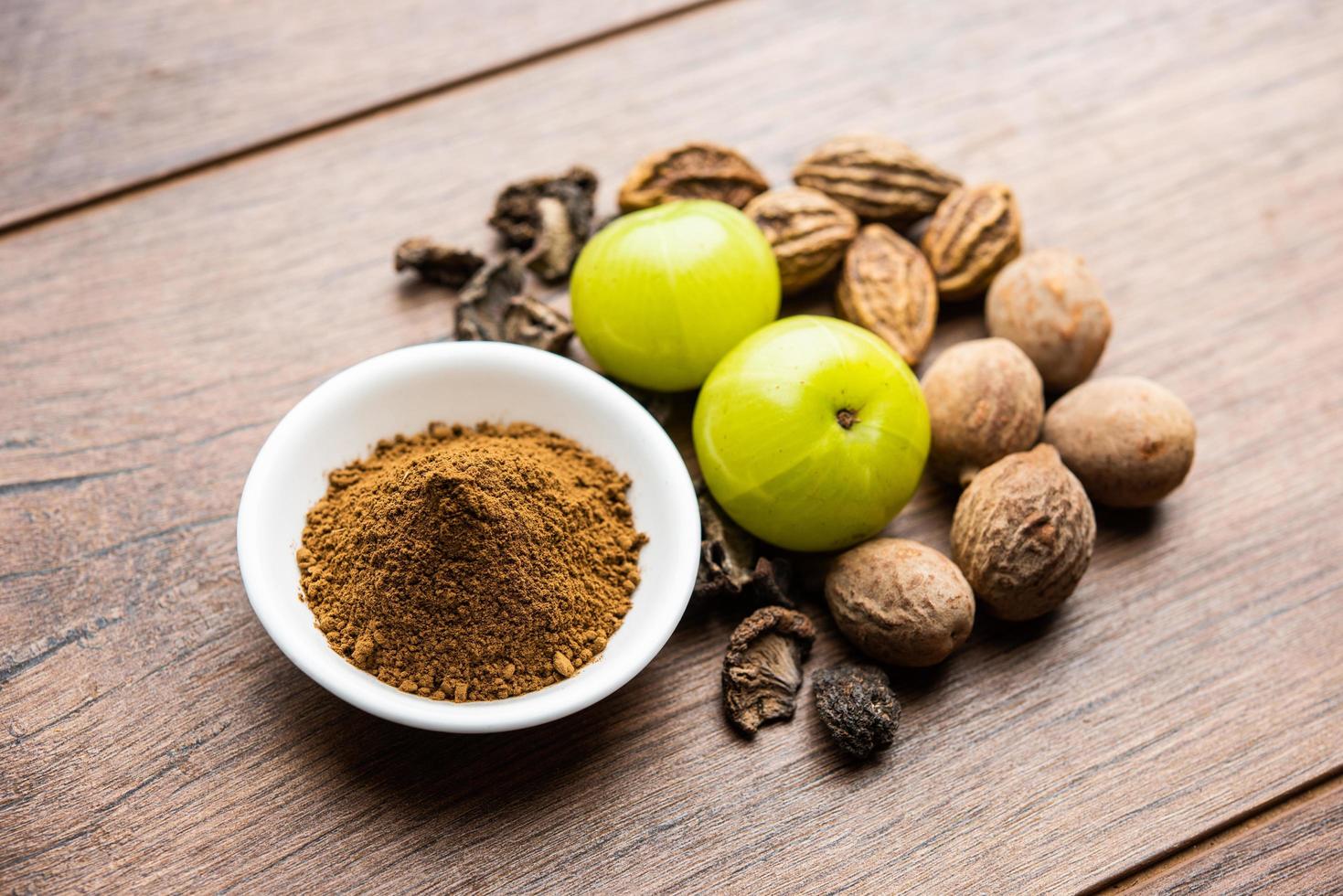
Triphala, one of the most widely used Ayurvedic formulations, consists of equal parts of Terminalia chebula (Haritaki), Terminalia bellirica (Baheda), and Emblica officinalis (Amla). Its phytochemical profile includes tannins (gallic acid, ellagic acid, chebulinic acid), flavonoids, saponins, and polyphenols.
- Triphala has demonstrated multiple gut health benefits, including modulation of gut microbiota, enhancement of antioxidant defense systems, and regulation of inflammatory pathways. It increases beneficial bacteria such as Lactobacillus and Bifidobacterium while reducing pathogenic organisms like E. coli. Additionally, microbial metabolism of its polyphenols leads to the formation of bioactive metabolites such as urolithins, which exhibit anti-inflammatory and antioxidant properties.
- Experimental models have shown that Triphala reduces colonic inflammation, oxidative stress markers, and mucosal damage while improving epithelial integrity. It also inhibits key inflammatory pathways such as EGFR/Akt/ERK, supporting its potential role in cancer prevention and gastrointestinal disease modulation.
Conclusion
Triphala and Ayurvedic medicinal plants represent a promising class of natural therapeutics for gut health and microbiome modulation. Their multifaceted actions-including prebiotic effects, microbial diversity enhancement, anti-inflammatory activity, and epithelial protection-align with modern microbiome science. While preclinical and early clinical evidence is encouraging, further large-scale randomized controlled trials are required to validate efficacy, optimize dosing, and establish standardized formulations. Integrating Ayurvedic principles with microbiome research may provide a valuable framework for future personalized and preventive gastrointestinal medicine.1
References:
- Jangra B, Kulshreshtha S, Goyal A, Jachak SM. The role of gut microbiota in disease management: Ayurvedic perspectives on metabolic diseases and health. Phytomedicine Plus. 2025;5(1):100731. doi:10.1016/j.phyplu.2025.100731 https://www.sciencedirect.com/science/article/pii/S2667031325000041