
Introduction
Ayurveda is a traditional holistic medical system that originated in India, emphasizing personalized health, disease prevention, and overall well-being. It focuses on maintaining harmony between the body, mind, and spirit, with strong emphasis on an individual’s natural constitution (Prakriti) for diagnosis and treatment. Classical texts such as Charaka Samhita, Sushruta Samhita, and Ashtanga Hridaya describe extensive knowledge of medicinal herbs, formulations, and lifestyle guidelines for health promotion and disease management.1
Foundational principles of Ayurvedic medicine
Ayurveda is based on the concept of Panchtatvas (earth, water, fire, air, and space), which combine to form the Tridosha system.
- Vata (air and space), Pitta (fire and water), and Kapha (earth and water) regulate physiological functions
- Individual Prakriti determines disease susceptibility and treatment response
- Eight branches of Ayurveda include Kayachikitsa, Shalyatantra, and Rasayana
Therapeutic care integrates herbal, mineral, dietary, and lifestyle-based interventions tailored to individual constitution.2
Therapeutic modalities in Ayurveda
Ayurveda incorporates multidimensional treatment approaches aimed at physical and psychological balance.
- Panchakarma for systemic detoxification
- Rasayana for rejuvenation and geriatric care
- Satvavajaya for psychological and mental health management
With increasing empirical support, Ayurveda is being integrated into complementary and alternative medicine systems for holistic health promotion.3
Triphala: classical formulation and composition
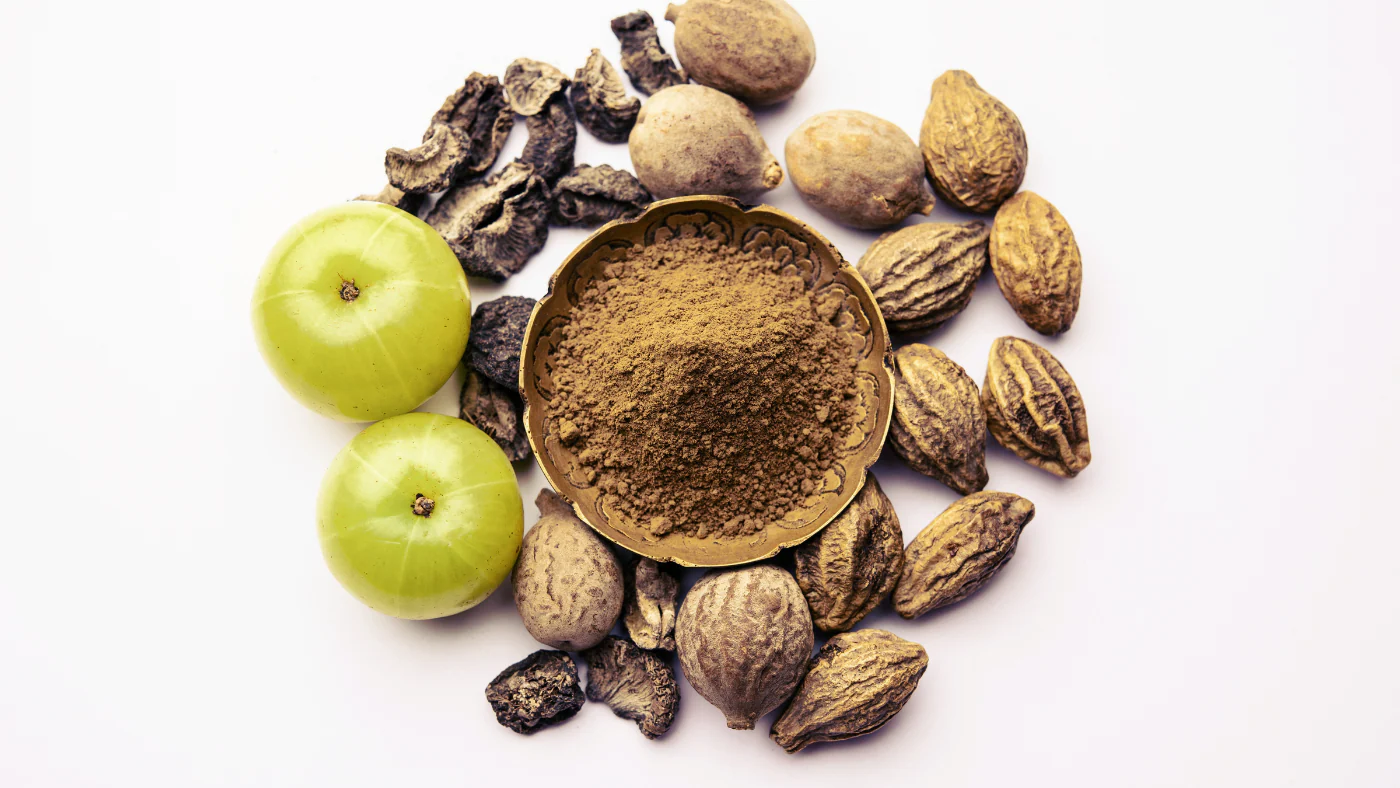
Triphala, meaning “three fruits,” is a well-known Ayurvedic polyherbal formulation consisting of:
- Emblica officinalis (Amla)
- Terminalia bellerica (Bibhitaki)
- Terminalia chebula (Haritaki)
It is traditionally used in a 1:1:1 ratio and is recognized as a tridoshic rasayana, supporting rejuvenation across age groups. It is also referred to as “Three-Fruit Harmony” and is valued for its detoxifying and digestive-supporting properties.4
Therapeutic properties and clinical relevance of Triphala
Triphala is considered Mahaaushadhi (supreme medicine) in classical texts and is widely used in gastrointestinal and systemic disorders.
- Exhibits antioxidant, anti-inflammatory, immunomodulatory, and free radical scavenging activity
- Supports digestive function, cholesterol regulation, and circulatory balance
- Contributes to endocrine balance and immune system support
- Demonstrates hematopoietic effects by promoting RBC and haemoglobin production
- Shows relevance in stress-related conditions, metabolic disorders, skin, liver, and dental health
Its synergistic action of the three fruits enhances therapeutic efficacy, particularly in metabolic regulation.
Future perspectives in Triphala research
To establish Triphala as a globally accepted therapeutic agent, further research is needed focusing on:
- Pharmacokinetics and bioavailability
- Molecular mechanisms of action
- Effects on gene expression
- Microbiota modulation and cell signaling pathways
Conclusion
Ayurveda provides a structured, constitution-based system of healthcare integrating preventive and therapeutic strategies. Within this framework, Triphala stands out as a multidimensional formulation with significant metabolic and systemic benefits. Strengthening scientific validation through modern research approaches may further enhance its global therapeutic relevance.5,6
References:
1. Patwardhan B. Bridging Ayurveda with evidence-based scientific approaches in medicine. EPMA J. 2014;5(1):19. Published 2014 Nov 1. doi:10.1186/1878-5085-5-19. https://pmc.ncbi.nlm.nih.gov/articles/PMC4230501/
2. Mukherjee PK, Harwansh RK, Bahadur S, et al. Development of Ayurveda - Tradition to trend. J Ethnopharmacol. 2017;197:10-24. doi:10.1016/j.jep.2016.09.024. https://linkinghub.elsevier.com/retrieve/pii/S0378-8741(16)30782-6
3. Parasuraman S, Thing GS, Dhanaraj SA. Polyherbal formulation: Concept of ayurveda. Pharmacogn Rev. 2014;8(16):73-80. doi:10.4103/0973-7847.134229. https://pmc.ncbi.nlm.nih.gov/articles/PMC4127824/
4. Dwivedi S, Chopra D. Revisiting Terminalia arjuna - An Ancient Cardiovascular Drug. J Tradit Complement Med. 2014;4(4):224-231. doi:10.4103/2225-4110.139103. https://pmc.ncbi.nlm.nih.gov/articles/PMC4220499/
5. Baliga MS, Meera S, Mathai B, Rai MP, Pawar V, Palatty PL. Scientific validation of the ethnomedicinal properties of the Ayurvedic drug Triphala: a review. Chin J Integr Med. 2012;18(12):946-954. doi:10.1007/s11655-012-1299-x. https://link.springer.com/article/10.1007/s11655-012-1299-x
6. Bairwa VK, Kashyap AK, Meena P, Jain BP. Triphala's characteristics and potential therapeutic uses in modern health. Int J Physiol Pathophysiol Pharmacol. 2025;17(2):19-36. Published 2025 Apr 25. doi:10.62347/OBSS5026. https://pmc.ncbi.nlm.nih.gov/articles/PMC12089839/#sec18