
Introduction
The aging population in India is increasing at a rate nearly three times faster than the general population, primarily due to increased life expectancy. A significant proportion of older adults report medical conditions, with approximately 27.72% experiencing either acute or chronic illness. With advancing age, there is a progressive decline in muscle mass, strength, and functional capacity, leading to reduced quality of life and increased healthcare burden.1
Age-related physiological and functional decline
Aging is associated with multiple structural, metabolic, and functional changes that affect overall health and independence.
- Gradual loss of muscle mass and strength contributes to reduced physical performance.
- Chronic musculoskeletal disorders significantly impact quality of life across multiple domains.
- Functional limitations increase due to co-existing morbid conditions, often with limited therapeutic responsiveness in older adults.
- The burden of age-related diseases continues to rise, with management challenges due to multiple underlying comorbidities.2
These conditions collectively reduce total functional ability and restrict daily activities, leading to increased dependency in older populations.
Pathophysiology of aging and associated disorders
The biological aging process is closely linked to cumulative cellular damage over time.
- Damage to biological macromolecules acts as an endogenous factor contributing to aging.
- This results in oxidative stress, which is a key mechanism underlying cellular dysfunction.
- Progressive accumulation of cellular damage leads to loss of physiological function.
- Sleep disturbances and reduced sleep quality are commonly observed in older adults and are associated with decreased quality of life.3
Ayurvedic perspective and Rasayana therapy
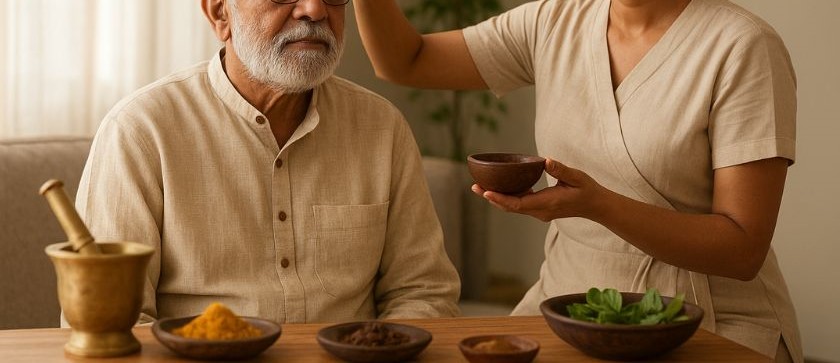
Ayurveda offers a structured approach to aging through Jarachikitsa and Rasayana therapy, focusing on health promotion, disease prevention, and rejuvenation.
Rasayana is defined as a therapeutic approach involving medicines, dietary practices, and lifestyle measures that enhance longevity and overall vitality.
Key functions of Rasayana therapy include:
- Vayasthapanam (delaying aging process)
- Ayushkaram (enhancing life expectancy)
- Medha (improving cognitive function)
- Bala (increasing physical strength)
- Disease prevention and health maintenance
Studies indicate that Rasayana drugs exhibit strong antioxidant properties and may counteract oxidative stress by reducing free radical activity. When combined with dietary supplementation, these formulations contribute to improved physiological resilience.4
Clinical relevance of Rasayana-based interventions
Herbal formulations categorized under Rasayana therapy have demonstrated potential benefits in geriatric populations.
- Ayush Rasayana A and Ayush Rasayana B are herbal-based coded formulations derived from classical Ayurvedic texts.
- These preparations are associated with improved health-related quality of life.
- Functional capacity and cognitive performance have shown improvement with their use in clinical settings.5
Conclusion
Aging is associated with progressive physiological decline, increased disease burden, and reduced functional capacity, largely driven by oxidative stress and cumulative cellular damage. Ayurveda addresses these challenges through Rasayana therapy, which focuses on rejuvenation, prevention, and functional restoration. Emerging evidence suggests that Rasayana-based interventions may support improved quality of life, cognition, and physical function in older adults, offering a structured approach to geriatric care within Ayurvedic practice.6
References:
1. Banerjee S. Determinants of rural-urban differential in healthcare utilization among the elderly population in India. BMC Public Health. 2021;21(1):939. Published 2021 May 17. doi:10.1186/s12889-021-10773-1. https://pmc.ncbi.nlm.nih.gov/articles/PMC8130530/
2. Kumar S G, Majumdar A, G P. Quality of Life (QOL) and Its Associated Factors Using WHOQOL-BREF Among Elderly in Urban Puducherry, India. J Clin Diagn Res. 2014;8(1):54-57. doi:10.7860/JCDR/2014/6996.3917. https://pmc.ncbi.nlm.nih.gov/articles/PMC3939587/
3. Bürkle A. Mechanisms of ageing. Eye (Lond). 2001;15(Pt 3):371-375. doi:10.1038/eye.2001.139. https://www.nature.com/articles/eye2001139
4. Balasubramani SP, Venkatasubramanian P, Kukkupuni SK, Patwardhan B. Plant-based Rasayana drugs from Ayurveda. Chin J Integr Med. 2011;17(2):88-94. doi:10.1007/s11655-011-0659-5. https://link.springer.com/article/10.1007/s11655-011-0659-5
5. Govindarajan R, Vijayakumar M, Pushpangadan P. Antioxidant approach to disease management and the role of 'Rasayana' herbs of Ayurveda. J Ethnopharmacol. 2005;99(2):165-178. doi:10.1016/j.jep.2005.02.035. https://pubmed.ncbi.nlm.nih.gov/15894123/
6. Mundada P, Makhija D, Mata S, et al. Effectiveness of Ayush Rasayana A and B on the Quality of Life of Older Adults: Protocol for a Cluster Randomized Controlled Trial. JMIR Res Protoc. 2024;13:e58186. Published 2024 Nov 11. doi:10.2196/58186. https://pmc.ncbi.nlm.nih.gov/articles/PMC11589494/#ref-list1